
Dahua DSS: how DeepAlert fits into the operator workflow

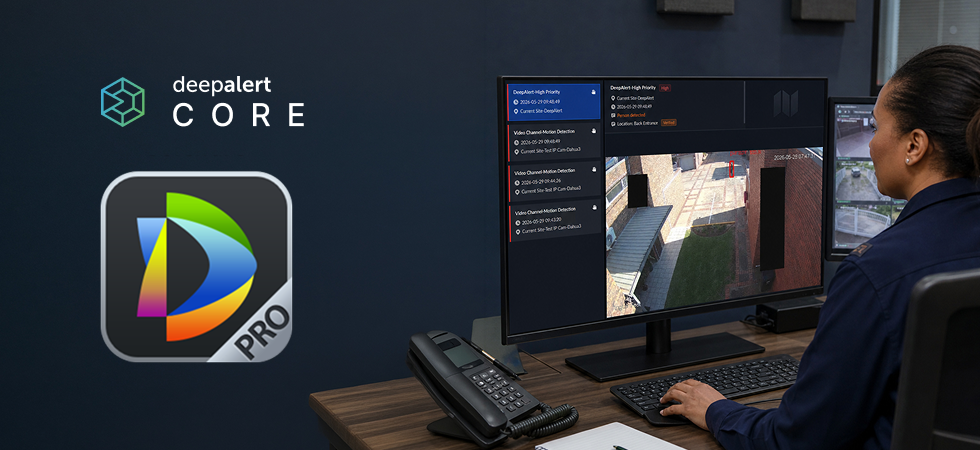
DeepAlert integrates with Dahua DSS Professional to add cloud-based AI verification to an existing VMS environment without requiring changes to the underlying camera estate.
Events generated in DSS are passed to DeepAlert for analysis. Nuisance activity can be filtered out, genuine activity classified, and from DSS Pro v8.5 onwards, verified alarms can be pushed back into DSS for operators to manage through their existing workflow.
This allows security teams to introduce additional AI capability while retaining their current VMS, cameras and operator processes.
Reduce operator workload and scale your business effortlessly
The primary role of DeepAlert Core is to reduce the volume of nuisance alarms operators need to assess manually.
Events caused by factors such as vegetation movement, animals, weather and changes in lighting can be filtered before they reach the operator.
Alerts associated with genuine activity, including people and vehicles, can then be passed into the monitoring workflow with additional classification and context.
This reduces the amount of time operators spend reviewing low-value motion events and allows greater attention to be given to activity that may require a response.
DeepAlert does not replace the operator response process. Acknowledgement, escalation, dispatch and event closure remain within the control room’s established procedures.
Less alerts means less operator workload enabling the scaling of your business.
Extending the analytics available in DSS
The integration can also provide additional analytics beyond basic false-alarm filtering.
CorePlus allows organisations to apply additional detection rules across connected cameras, including person and vehicle detection, schedules, zones and site-specific logic. These rules can be introduced without changing the existing camera or VMS configuration.
Together, these capabilities allow an existing DSS deployment to make use of additional AI functionality without replacing the underlying surveillance infrastructure.
Monitor directly within DSS
For DSS Pro v8.5 and above, verified DeepAlert alarms can be pushed back into DSS.
This allows operators to continue using the VMS interface and alarm-handling processes already in place, while DeepAlert performs filtering and analysis in the background.
For organisations with established control-room procedures, this provides a way to introduce AI verification without changing the operator front end.
How DeepAlert works with DSS
DeepAlert operates as an additional analytics layer alongside the existing environment. A lightweight DeepAlert Windows application is installed on the existing VMS server or on a Windows machine alongside it.
The integration requires:
- A DeepAlert Windows application running on the DSS server or an adjacent Windows machine
- Alert sync license per camera (provided by DeepAlert)
- Local connectivity between DSS and the DeepAlert connector
- Outbound HTTPS connectivity for event imagery sent to the DeepAlert cloud
- DSS Pro v8.5 or later where verified alarms need to be pushed back into DSS
The existing cameras and video storage architecture remain unchanged.
DeepAlert evaluates the event and applies the appropriate analytics before returning the result to the monitoring workflow.
Raw video remains on site. Only the event snapshots and clips required for analysis are sent to DeepAlert, reducing bandwidth requirements and avoiding unnecessary movement of continuous video streams.
Part of DeepAlert’s VMS integration framework
Dahua DSS Professional is one of several VMS platforms supported by DeepAlert, alongside systems including Milestone XProtect and HikCentral Professional.
For DSS environments, this means verified events can be analysed by DeepAlert and returned directly into the existing operator workflow.
Related Articles
No categories assigned to this post.