
Loitering Detection: Adding Context to Person Detection

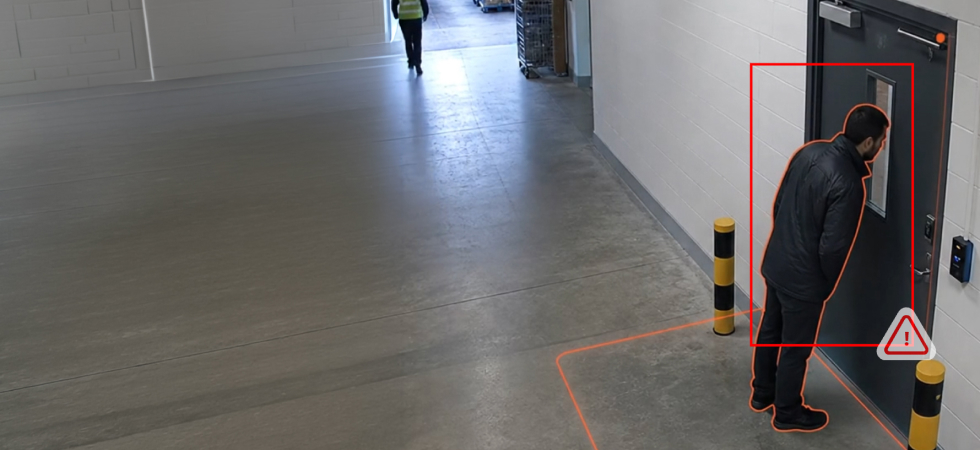
A person stops outside an entrance for a few seconds to check their phone. Another remains in the same place for several minutes.
A basic person-detection model may treat both events in much the same way: person detected near entrance.
For a security operator, however, duration can materially change the significance of the event.
DeepAlert CorePlus uses advanced analytics designed to account for that difference. Rather than identifying presence alone, it considers how long a person remains within a defined area and whether that dwell time exceeds the threshold configured for that location.
Presence alone is not always a concern
A person appearing on camera does not always require investigation.
They may be walking to a vehicle, waiting for a delivery, speaking on the phone or carrying out normal activity around the site.
In these cases, the detection itself may be accurate, but the event may have little operational significance.
At scale, this distinction becomes important. Across large camera estates, routine activity can create a substantial volume of unnecessary operator workload.
DeepAlert CorePlus Loitering Rule adds dwell time as an additional condition.
Instead of alerting purely because a person is present, the model can identify when that person remains within a defined area for longer than the configured threshold.
This helps monitoring teams reduce routine events and focus attention on activity that warrants review.
Loitering thresholds should reflect the site
There is no single dwell-time threshold that makes sense in every environment.
The significance of someone remaining in an area depends on how that area is normally used.
At a retail entrance, people may regularly stop to check their phones, wait for others or stand near the doorway. A short dwell time is unlikely to be unusual.
At a loading dock, drivers, contractors and staff may remain in the same area for extended periods as part of normal operations.
At a restricted area, however, legitimate stationary activity may be uncommon. A shorter dwell time may therefore justify investigation.
For this reason, loitering detection should be configured according to the site and zone rather than applied as a generic rule across an entire estate.
The objective is not simply to detect that someone has stopped moving. It is to identify when the duration of that behaviour becomes relevant in the context of the location.
Core and CorePlus address different parts of the monitoring workflow
DeepAlert Core is designed to reduce nuisance activity before it reaches the monitoring queue.
CorePlus includes Core’s functionality but extends that capability with more specific models that identify particular behaviours, conditions or scenarios.
Loitering is one example.
In practical terms:
Core determines whether an event is true.
CorePlus provides contextual relevance about that detection.
Loitering detection improves monitoring efficiency
The value of loitering detection is not limited to identifying potentially suspicious behaviour.
It helps reduce unnecessary operator workload.
Every event that reaches a monitoring queue consumes operator capacity. As the number of cameras increases, event volumes increase with them.
If monitoring centres rely on operators to manually assess large amounts of routine activity, growth can become increasingly dependent on additional headcount.
More selective analytics can help change that relationship.
By applying additional conditions before an event is presented, monitoring teams can reduce the amount of low-value activity entering the queue.
This can support:
- lower event volumes
- more focused operator attention
- faster review of higher-priority events
- greater monitoring capacity without a proportional increase in headcount
The objective is not to make operators process events faster. It is to reduce the number of events that require their attention in the first place.
Moving beyond basic detection
Basic video analytics in intruder detection answers a straightforward question:
Is there a person or vehicle in the image?
More advanced models can add another layer:
Does what is happening meet the conditions that make this event relevant?
A person being present may be completely normal. A person remaining in a particular area for an unusually long period may be more significant.
By distinguishing between the two, DeepAlert CorePlus Loitering Rule helps monitoring teams apply operator attention more selectively and manage larger camera estates more efficiently.
Related Articles