
Sheep, thieves and thermal cameras: detection on solar farms

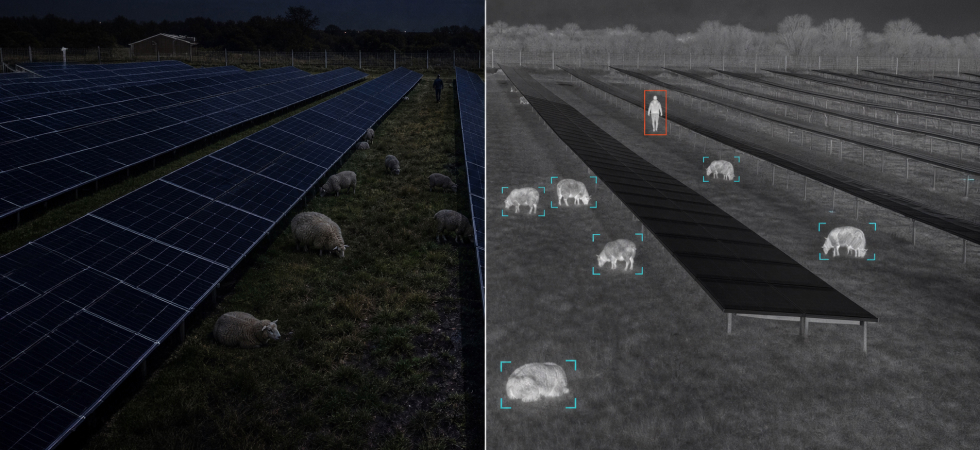
Solar farms are close to the worst type of sites an ARC can be asked to monitor. They’re unmanned, usually miles from anywhere, the perimeter runs for kilometres, and there’s no lighting across most of it because nothing out there needs light to work.
They also hold a great deal of copper. Between January and August 2024, more than 750 kilometres of cable was reported stolen from UK solar sites across some 70 incidents, and repeat targeting is common — one operator was hit four times in six weeks. So these sites get cameras, and because the threat arrives after dark across an unlit perimeter, they increasingly get thermal cameras.
Then, in spring, the sheep arrive.
The flock is a feature, not a bug
Solar grazing is now standard practice on UK ground-mounted sites. Sheep keep the vegetation down without mowers throwing stones into the panels, they reduce fire risk, and they let the operator keep the land in agricultural use. Grazing typically runs through the growing season, roughly March to October.
For the control room, the relevant detail is where the sheep spend their time. They don’t stay politely in a corner of the field. Studies have found sheep preferentially graze beneath the panels rather than between the rows, and they use the arrays as shelter from wind and rain. So the flock lives directly against the infrastructure your cameras are pointed at, moving all night, in exactly the detection zones that matter.
Now consider what a thermal camera produces. It doesn’t see colour, wool, faces or clothing. It sees heat. And a sheep is a warm body moving through a cold field, which is precisely what the camera was installed to look for.
Where thermal earns its place
None of this is an argument against thermal on these sites. On a long, unlit perimeter, thermal is the only technology that works reliably.
Optical cameras on a solar farm at 2am are contending with near-total darkness, weather, and distances where a person occupies a handful of pixels against a low-contrast background. In internal testing on long-range, low-contrast scenes, there were repeated cases where a thermal-specific model returned a detection and the standard model returned nothing at all — the person was genuinely in frame and genuinely visible, but the visual detail an optical model depends on simply wasn’t there.
For a site where the realistic loss from a single incident runs into six figures, the difference between an alert and silence is the whole point of monitoring it.
Where thermal misleads
The failure mode isn’t that thermal misses things. It’s that heat shape isn’t the same as human shape, and a detection model built for ordinary video doesn’t know the difference.
We have a clear example of this from our own testing. On a thermal image, the standard detection model confidently classified a dog as a person. The thermal-specific model did not. Same frame, same animal, two different answers — and the wrong one produces an alert that an operator has to open, assess and close.
Scale that to a flock. If your detection is being handled by a model that reads a warm quadruped as a person, a solar farm with sheep on it overnight doesn’t generate a few nuisance alerts. It generates them continuously, from March to October, on a site that was supposed to be quiet. That’s the point at which an ARC either stops trusting the site or starts filtering it out of the queue — and a site nobody is really watching is worse than no camera at all.
What actually changes
The fix isn’t more sensitive detection. It’s detection built for the imagery it’s reading.
DeepAlert routes thermal cameras to a model developed specifically for thermal, rather than running one general-purpose model across every camera on the estate. That model is tuned for what thermal sites actually present: long ranges, small warm objects, and animals that need to be told apart from people. The result is fewer nuisance alerts on grazed sites, and detections the operator can act on without second-guessing.
It doesn’t eliminate false alarms, and we don’t claim it does. What it changes is which of them survive to reach the queue.
The question worth asking your own estate
If you monitor solar farms, agricultural sites, or anywhere livestock and perimeters share the same ground, the useful audit isn’t whether the thermal cameras are working. It’s whether they’re being read by a model built for thermal — or by the same model handling the rest of your optical estate. In a mixed estate that’s a per-camera question, not a per-site one, and it’s easy to get wrong quietly at commissioning and never revisit.
What proportion of your sites run thermal today?
Related Articles