
Detection is the Easy Part: Why Video Monitoring SOPs Matter

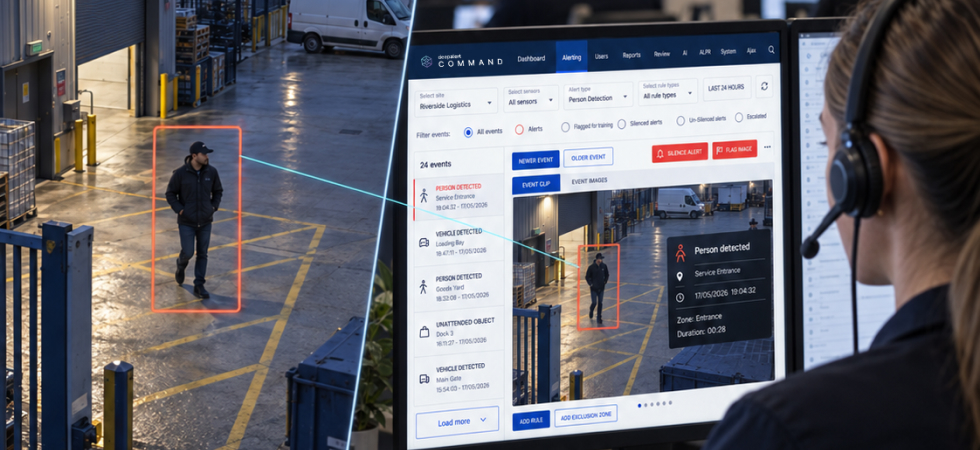
Most video analytics demos end in roughly the same place. Something moves, the system classifies it, an alert appears, and the demo finishes at precisely the moment the interesting part begins.
Because what determines whether that alert was worth anything isn’t simply whether the system spotted it. It’s whether the operator understands what is happening, has the right context to make a decision, knows what they are authorised to do next, and can act quickly.
Much of that second half belongs to the monitoring operation, not the detection model.
The part our industry finds easiest to sell
Detection is relatively easy to demonstrate, measure and improve. So it has naturally become a major focus for the video analytics industry. And genuine progress has followed.
Classification has improved significantly over the past five years, and good analytics can now remove a substantial amount of nuisance activity before it reaches an operator.
But detection accuracy is still an input.
What matters to the client is what happens after the event is detected.
Between detection and response sits the work that converts an alert into action: context, verification, routing, authority, escalation and a defensible record of what happened.
Those of us on the technology side of the industry, ourselves included, can be quick to describe an improvement in detection as an improvement in operations.
On its own, it isn’t.
The operational value is created when the monitoring operation knows what to do with that better information.
SOPs turn detection into action
This is worth saying plainly, because standard operating procedures can easily be treated as back-office housekeeping rather than the operational asset they are.
Monitoring operations have spent decades building procedural depth. An experienced ARC has knowledge encoded in its SOPs that no detection model has an equivalent of.
That procedural layer is what turns a flagged event into a response.
The alert tells the operator what has happened. A good SOP adds the operational context: what that event means for this particular site, what action is authorised, who needs to be contacted and how quickly.
A good SOP is the difference between an operator who hesitates and one who acts with confidence, knowing what action to take under different circumstances, who to contact and how quickly to act.
Detection technology raises the quality of the input.
SOPs determine what the operation gets out of it.
Good SOPs are written against assumptions. Those assumptions have moved.
This matters because the assumptions behind many escalation procedures are changing.
Most escalation processes were written for a queue where the majority of incoming activity needed to be filtered by a human before anything else could happen.
That was the correct design for that environment. Operators triaged first and acted second, and the procedure reflected that order.
As queues get cleaner, that sequence starts to change.
When operators spend less time filtering nuisance activity, they reach the decision point sooner. That puts more emphasis on what happens next: the context around the event, what it means for this particular site, who should be contacted and how quickly the operator should act.
An SOP that worked well for a noisy queue can therefore end up with its slowest step sitting exactly where a faster response is now possible.
That isn’t a failure of procedure.
It’s what happens when the inputs to a well-built process improve.
The process is worth revisiting for the same reason you would revisit a staffing model after a site expansion.
Questions worth putting to your own SOPs
A useful review exercise is to put an operations manager and a client-facing lead in the same room and work through a few practical questions:
- For each client, which actions can an operator take on their own authority, and is that written somewhere they can see it at 3am?
- Does the SOP distinguish between different contexts around the same type of alert?
- Does the operator have enough site and event context to make that distinction quickly?
- Does every escalation step have a defined response time?
- When was the out-of-hours contact chain last tested, rather than simply updated?
- Does the service agreement describe what happens after a verified event in language the client would recognise as a commitment?
- Does the outcome of a decision get back to the operator who made it?
The upside of getting this right
Better detection increases the value of good procedure rather than replacing it.
As the queue gets cleaner, good operational procedure matters even more. Operators spend less time dismissing nuisance activity and more time dealing with events that require a decision.
And the faster an operator reaches that decision point, the more important it becomes that the right context, authority and next action are already clear.
That means monitoring operations with the strongest procedural discipline stand to gain the most from improvements in detection.
It also means the investment already made in SOPs, training and accreditation becomes more valuable as the technology improves, not less.
Related Articles