
Camera Health Monitoring: Why Flagging a Fault Isn’t Enough

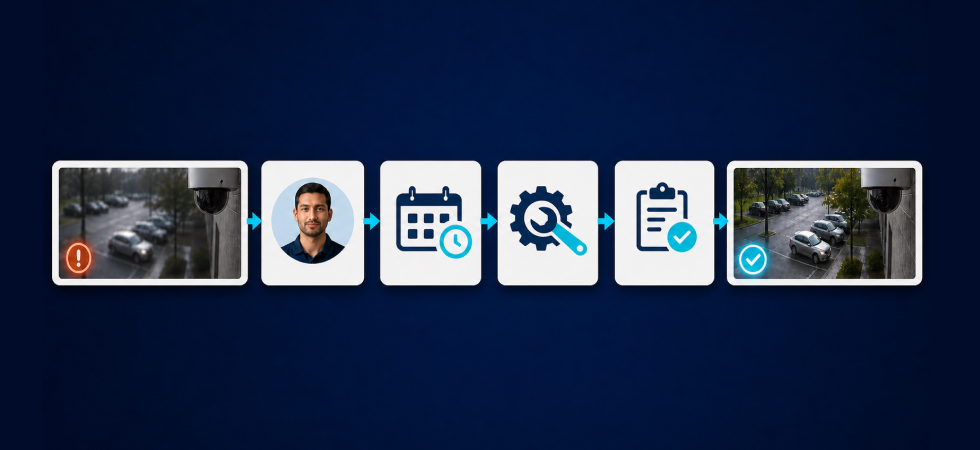
Most control rooms have some visibility of camera status, because it comes free with the platform they already run. It shows whether the camera is online, offline, recording, or dropped. Fewer have a report telling them which cameras are still connected but no longer seeing anything useful: lens obscured, scene changed, focus gone soft, a spider building a web across the view at 3am.
That second category is the genuinely useful piece, but what it can’t do is close the loop it opens.
A flagged camera and a fixed camera are two entirely different things, and the distance between them is not covered by any detection model. It is covered by a process — a named person, a deadline, an escalation path and a record. Most operations have the tooling and not the process, and then quietly conclude the tooling didn’t work.
Detection is finished. The loop isn’t.
The health report lands in a shared inbox. Someone reads it. The faults are real, but none of them are urgent this shift, because a blind camera doesn’t page you — it just sits there producing nothing. The list is noted. The list is not actioned. Next week’s list arrives and it’s longer, because last week’s faults are still on it, so now the report is a bit harder to read. Three weeks later nobody opens it at all.
There’s a reason this happens to image-quality faults far more than connectivity faults. A camera that drops offline usually trips something such as a signal failure, a black tile on a wall, a client asking why. It gets reflexive handling even in operations with no defined process at all. A camera that is online and blind doesn’t trip anything. It appears on a report, quietly, alongside nine others, and nobody’s shift is interrupted by it.
When an operation concludes that camera health monitoring “didn’t change much,” this is almost always what happened. The tooling revealed a fault that would otherwise have stayed invisible until footage was needed. What it couldn’t do was answer the question it raised: and then what?
The structural gap
The uncomfortable part is that in most monitoring arrangements, the party who can see the fault is not the party who can fix it.
The ARC sees that camera 14 has gone dark. The ARC does not own camera 14. The installer or integrator who commissioned the estate can fix it, but they aren’t watching the queue and may not have been told. The end client owns the asset, controls site access, and often has to approve the callout that costs money. Three organisations, one fault, and frequently no contractual owner of the space in between.
So the fault gets communicated via a monthly review call, added to a report, or raised with a site contact who has left the company, rather than assigned to a specific person or department to solve the issue.
That is a process problem. No amount of better detection touches it.
What a follow-through process actually has to answer
If you want camera health to change outcomes rather than generate documentation, the process behind it has to answer four questions, in advance, in writing:
Who receives this specific fault? Not “the client” or “the installer” — a role, with a current contact, per site.
What is the expected time to resolution, by fault type? A camera offline at a high-risk perimeter site is not the same job as a slightly soft focus on an internal corridor. If everything is flagged at the same weight, everything gets triaged at the same weight, which in practice means the easy ones get done.
What happens when the deadline passes? This is the question almost nobody has answered. If a fault is unresolved after seven days, does it escalate to the account manager? Does it appear in the client’s monthly report as an open item? Does it get raised at contract review? Without a consequence, the deadline is a suggestion.
Where is the record of open and closed? A list of faults found and a list of faults resolved are two different documents, and only one of them is worth anything later.
The log only works if it closes
Operations managers often frame camera health as a client-trust asset, and it can be. A per-camera history showing when a fault appeared, when it was flagged, when it was actioned and when it was resolved is a strong thing to put in front of a client at renewal.
But that only holds if the log closes.
A log with detection and no resolution field records that a fault was found and leaves the rest blank. In a dispute over an incident on a blind camera, that becomes an issue
Where the tooling stops
Automated camera health is worth having. Faults like blind or obscured lenses, cameras knocked off their scene, dropped streams and gradual image degradation are genuinely hard to catch manually across a large estate, and catching them early is how you avoid finding out at the worst possible moment.
But none of that is a maintenance function. It is a detection function pointed at your equipment instead of at intruders, and like every other detection function in this industry, its value is set entirely by what a human does next.
Which is the question worth taking to your next ops meeting rather than answering from memory:
What actually happens at your organisation between a camera fault being flagged and it being fixed? Not what’s supposed to happen. What happens? Who gets it, how long they have, who notices if they don’t, and where anyone would look to prove it.
If that answer takes more than a sentence, the gap isn’t in your tooling.
Related Articles