
Beyond Standard Detection: Specialised AI Video Analytics for Real-World Risks

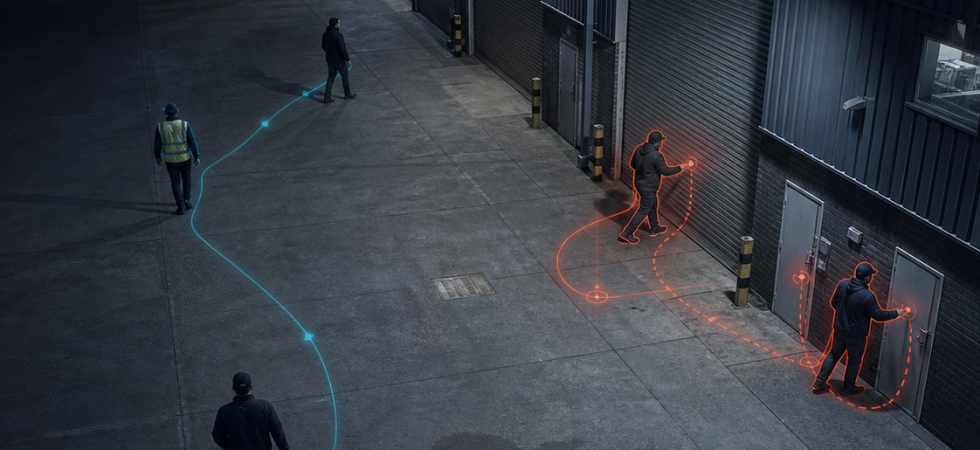
A conventional motion sensor can tell you that something moved but cannot tell you whether that movement matters.
For an operator, that is not intelligence. It is simply another event that needs to be investigated.
Our standard DeepAlert Core product takes the motion trigger and detects whether there is a person or vehicle in the frame. This is helpful in areas where people or vehicles should not be during certain hours of the day depending on how you’ve configured your rules.
But why stop there? There are much more interesting camera environments and behaviours we may want to consider in AI video analytics.
Understanding more complex camera environments
Advanced analytics are not only about behaviour. They must also work across the variety of cameras already deployed in real surveillance environments.
Thermal detection
Thermal cameras are frequently used on remote sites, large perimeters and in low-light conditions. However, heat signatures alone can create nuisance events from animals, environmental conditions and other sources.
CorePlus applies purpose-built thermal detection models to distinguish people and vehicles from irrelevant heat signatures, turning thermal events into more reliable, actionable alerts.
Fisheye camera analytics
Fisheye cameras provide wide-area coverage, but their distorted images can be challenging for conventional analytics.
CorePlus supports specialised analysis for fisheye views, allowing organisations to gain more value from broad camera coverage while reducing the amount of footage operators need to review manually.
Virtual guard tours
Traditional guard tours depend on someone checking cameras or physically visiting locations at scheduled intervals.
CorePlus enables proactive, AI-supported virtual patrols across selected cameras. This allows monitoring providers to deliver more consistent tours across larger estates without proportionally increasing operator workload.
AI performs the initial review. Operators become involved when something relevant requires human judgement or action.
There are much more interesting camera environments and behaviours we may want to consider in AI video analytics.
Detecting behaviour, not simply presence
DeepAlert CorePlus is designed to launch video analytics beyond basic people and vehicle detection. Instead of asking whether a person or vehicle is present, it applies specialised AI models to understand more about the scene, the behaviour, and the operational risk that may be applicable.
The result is not more alerts. It is more useful alerts that are actually actionable.
Suspicious activity is rarely defined by the presence of a person alone. It is usually defined by what that person is doing, how long they have been doing it and whether the behaviour fits the environment.
CorePlus can support use cases such as:
Loitering
A person passing through an entrance may be completely normal. The same person remaining near the entrance for an unusual length of time may justify attention.
CorePlus can assess dwell time against thresholds appropriate to each site or area. A loading dock, retail entrance and server room may each require different rules.
The system does not simply flag that someone is present. It identifies when that presence has continued beyond what the customer considers normal.
Suspicious activity
Some environments operate around the clock, which means after-hours activity is not automatically suspicious.
At a self-storage facility, for example, customers may legitimately access their units late at night. The more relevant signal may be behaviour associated with avoiding identification, such as concealing the face or repeatedly positioning the head away from the camera.
CorePlus helps distinguish ordinary access from behaviour that warrants closer inspection.
Person prone
A person lying on the ground can indicate a fall, injury or medical emergency. It may also represent a safety concern in construction areas, warehouses, healthcare facilities or guardrooms.
The Person Prone model is designed to identify this specific condition, helping operators respond to a potential welfare incident rather than waiting for someone else to notice it.
PPE compliance
On an active construction or industrial site, the problem is not that people are present. They are supposed to be there.
The question is whether they are wearing the required protective equipment.
CorePlus can identify people without items such as hard hats or high-visibility clothing, allowing safety teams to focus on the individual compliance issue rather than treating the entire scene as an alarm.
Camera health is part of detection accuracy
Even the best AI model cannot perform reliably if the camera cannot see clearly.
A camera may technically be online while its operational value has been compromised by:
- Water droplets
- Spider webs
- Bright or flaring lights
- Lens blur
- Poor image clarity
- Scene movement or obstruction
- Loss of video
CorePlus includes enhanced camera health capabilities that look beyond a simple online or offline status.
By identifying visual conditions that could reduce detection accuracy, the system helps monitoring providers and installers address problems before they lead to missed events.
This changes camera maintenance from a reactive process into a more proactive operational discipline.
Detecting when the scene itself has changed
Cameras are frequently moved, obstructed or repositioned without the monitoring centre immediately knowing.
A camera that was intended to cover a gate may gradually shift toward a wall. A stored object may block a critical area. Vegetation may obscure the perimeter.
Scene Change detection identifies meaningful changes to the expected field of view, helping teams investigate whether the camera still provides the coverage it was configured to deliver.
Being connected is not the same as being effective.
Why precision matters
Every alert creates work, even when nothing is wrong.
An operator must review it. A guard may be redirected. A site manager may be contacted. In more serious cases, an emergency service or response team may be dispatched.
Repeated nuisance events increase costs, slow response times and gradually weaken operator trust in the alarm system.
That last consequence is often the most dangerous.
When operators become accustomed to irrelevant events, genuine incidents become harder to recognise quickly. More alarms do not necessarily create better security. They can create more noise between the operator and the event that matters.
CorePlus is designed to make alerts more specific, more contextual and more closely aligned with the risks each customer needs to manage.
Because the purpose of AI video analytics is not to prove that something moved.
It is to help people understand what happened, whether it matters and what should happen next.
DeepAlert’s wider platform combines AI filtering, camera health notifications, live streaming, configurable operating procedures and reporting to support efficient, accountable monitoring operations.
Which of these specialised detection models would make the biggest difference in your operation?
Related Articles